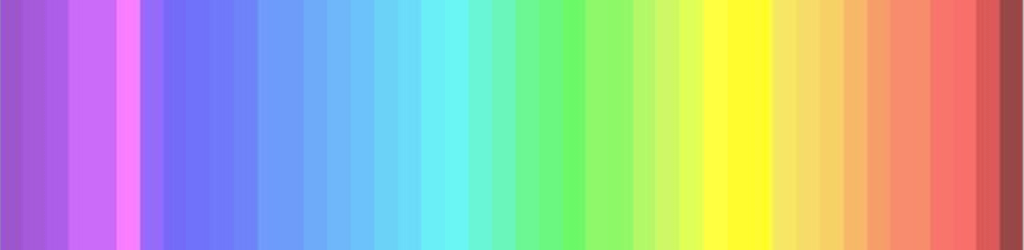
Recently there was a schism on the internet between people about the color of a dress.  That led to all kinds of scientific articles about how we perceive color differently, memes about white and gold things and black and blue things, and finally, eventually, this.

Screen Shot 2015-03-02 at 4.13.41 PM

That is from an article on LinkedIn, written by a woman named Diana Derval, who claims to be an expert in neuromarketing, whatever the fuck that is.  The title of the article looks like this:

Nothing says legitimate scientific knowledge like a winky face with its tongue out.

This is already almost a hundred percent incorrect, but in order to explain why, I need to give you a little anatomy lesson.

Vision starts in the eye.  There are three sets of cells in the eye called “cones” and one set called “rods.”  Rods only have one kind of light-sensitive pigment in them, which means they can only tell how much light is coming in, not what color it is.  They are far more sensitive than cone cells and are almost entirely responsible for low-light vision, but have little to no role in color vision.

The majority of people have three cones, called L, M, and S for the long-, medium-, and short-wavelength light they detect.  After the pigments pick up light, they are sent to the brain along three channels, one for each color.  L corresponds with red, M with green, and S with blue.

Roughly one in sixteen men is what’s called red-green colorblind, which is a slightly misleading term.  The correct term is anomalous trichromacy, meaning they have two fully functioning sets of cone cells instead of three.  The S (blue) set is fine, but either the M (green) has sensitivity shifted toward the red portion of the spectrum, or the L (red) has shifted toward the green.  Importantly, though, the brain does not know that this has happened.  This is a genetic condition that affects the eyes, but not the color-sensing portion of the brain.  The brain assumes that each cone is sending it the correct color and builds images accordingly.

I, for example, am deuteranomalous.  I have a perfectly functional set of S cones and a perfectly functional set of L cones, but my M cones are shifted toward the L end of the spectrum.  This means, theoretically, that I am less sensitive to green light than a person with normal vision, but I can’t tell.  As far as my brain is concerned, the signals are coming through fine.

Here’s an example.  Imagine a gray square, composed of equal parts blue, red, and green light.  Then you turn up the red and blue light, making the gray square a sort of dull magenta color.  To you, that square is now magenta. My stupid deformed M cones, however, are detecting red when they shouldn’t be, so they detect the increase in red light as well.  They report back to the brain that the green levels have gone up, when they haven’t. My brain is now getting signals that all three channels of light have increased in magnitude and the square is now a brighter shade of gray.  It’s not.  It’s pink.  But I can’t tell.  Want to see that in action?
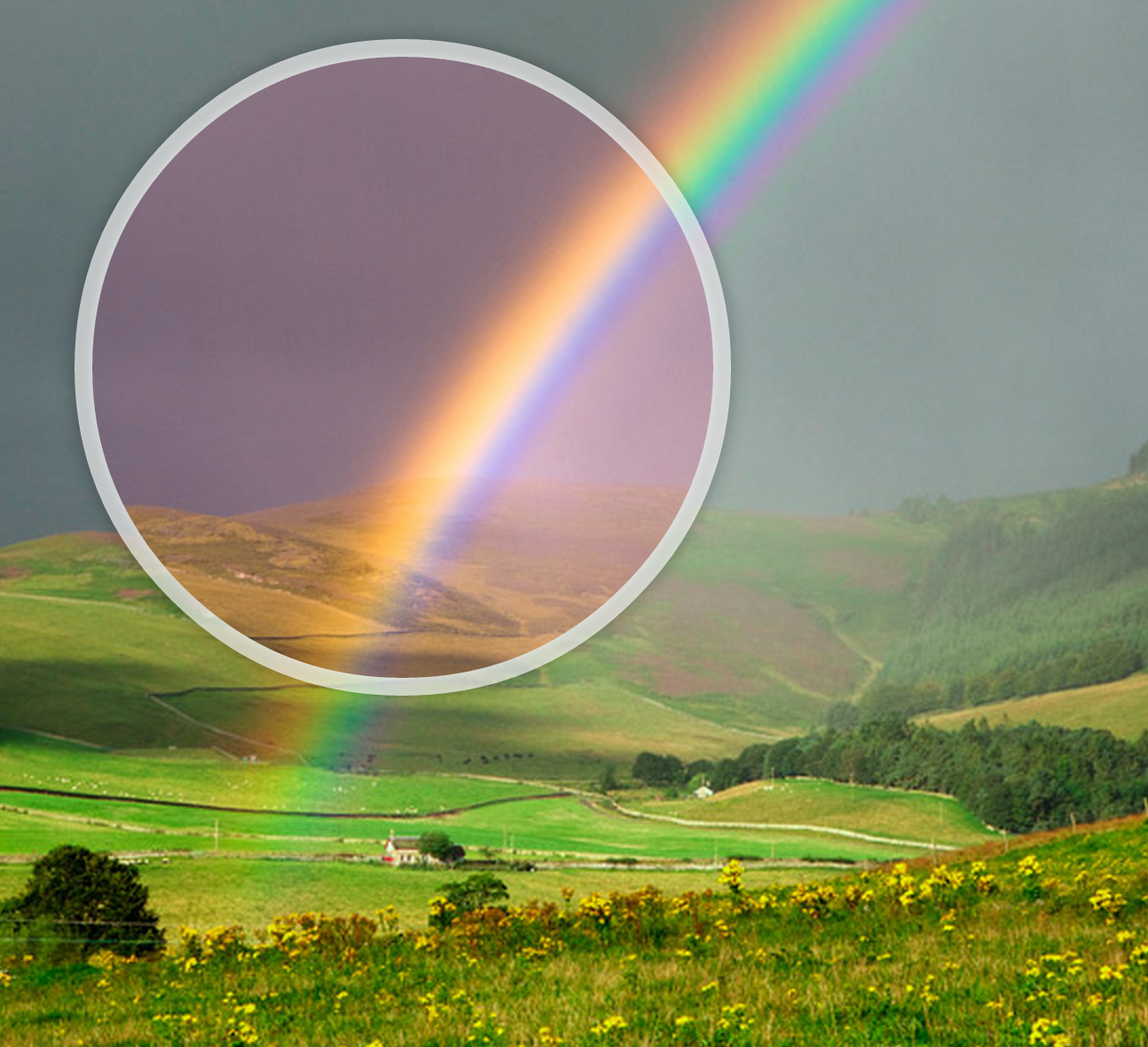
Screen Shot 2015-03-02 at 5.04.32 PM

This is a graphic to test my particular flavor of color blindness.  My coworker assures me that the sky inside the circle is pink, but I can’t tell because my dumbfuck M cells think that the increase in red and blue is an increase in all three colors, which cancels out.  I can tell that it’s not exactly the same as the other sky, but it’s more of a texture than a color.  She tells me that the grass in the circle is yellower (because red light was added to the existing green), but I can’t tell for the same reason.  The gist of it is that if something is pure green, it looks paler to me.  If you add red to something, I can’t tell.  Dark blue and purple are a nightmare. Traffic lights look very pale, almost blue.  Dull greens look brown because I can’t see the green part.  And so on.

This brings me back around to tetrachromacy, or the presence of four sets of cone cells.  A Dutch researcher in the 1940s noticed that the mothers and daughters of deuteranomalous men like myself all had normal color vision.  He knew that the genes responsible for cone cells came from sex chromosomes, which left two possible explanations.  If the mutated M cells came exclusively from the father, all fathers and sons of deuteranomalous men would have the same condition, which wasn’t the case.  If they came in equal part from the mother, then deuteranomaly would be similarly present in women, which wasn’t the case.  He concluded, therefore, that the mothers and daughters of deuteranomalous men must have a fourth set of cells, giving them three functional ones and one mutant.  He hypothesized that women with four functional sets of cells might exist, but it wasn’t the point of his research so he didn’t look into it.

This has been a long wall of text. Here is a cat being friends with a horse.

Fast forward to 1980, when two researchers became intrigued by the idea of four-coned women.  They knew that anomalous trichromacy was common, which meant that four-coned women must be common as well.  They sought out the mothers and daughters of colorblind men and had them take a color matching test.  In such a test, the subject mixes levels of red and green light to match the yellow light provided.  Colorblind men will have to add more of either red or green to compensate for their defective cones, and people with normal vision will be able to match the colors correctly.  People with four cones, theoretically, would be able to tell the difference between true yellow light and light made by mixing red and green, and would therefore be unable to make a match.  That wasn’t the case.  The researchers found plenty of women with four sets of cones, but none of them had more sensitive color vision than the average trichromat.

In 2007, one of the researchers tried a different technique.  She flashed three colored circles in front of her subjects’ eyes.  A trichromat would have been unable to tell them apart, but a tetrachromat should have been able to recognize that one of the circles was actually a very subtle mix of red and green, rather than a solid yellow color.  Only one woman was able to pass the test.  Which brings me to my point (1100 words later):

If two researchers who dedicated their careers to the task were only able to find one functional tetrachromat in 27 years, do you really think that a test on LinkedIn written by a marketing professor is going to help?

Obviously, the answer is no.  But there’s more bullshit here.  First, the title.

25% of people are tetrachromats

Lies.  It’s something like 12% of women, which is 6% of people — and is probably more common in women of Northern European ancestry, so that number’s even lower worldwide — and it’s so rare that women with four cells can actually use them that we can’t even put a number to it.  Only two women in history have ever been empirically confirmed as functional tetrachromats.

and see colors as they are

That’s a preposterous thing to say.  Everyone’s cones see slightly differently already due to genetic variation, so theoretically the same wavelength of light looks infinitesimally different to every single person.  The only reason color blindness is a thing is that color blind people can’t distinguish between certain colors, not that they’re seeing them wrong.  Sure, you can empirically say that a certain LED bulb emits light at a wavelength of 581nm, but what does that look like?  No one can really say for sure.  There is no such thing as colors “as they are.”

You see less than 20 color nuances: you are a dichromats, like dogs, which means you have 2 types of cones only. You are likely to wear black, beige, and blue. 25% of the population is dichromat.

Horseshit.  Dichromacy affects less than 3% of males and .03% of women.  That’s about 1.5% of the general population.

You see between 33 and 39 colors: you are a tetrachromat, like bees

No part of that is true.  Firstly, you can’t diagnose tetrachromacy on a computer screen AT ALL because computer screens are made up of combinations of only three different colors of light.  It is literally not possible for an LED computer screen to generate the kind of nuance that distinguishes tetrachromats from trichromats.  Secondly, bees see in ultraviolet, meaning their extra color vision is in a wavelength that no human being (or even mammal)* has ever seen.  Being a tetrachromat in the visible spectrum does not mean you can see what bees see.  And thirdly, BEES ARE NOT TETRACHROMATS. Bees are trichromats, with cones in what we might call the green-yellow, blue, and UV portions of the spectrum.  They still only have three cones.

It is highly probable that people who have an additional 4th cone do not get tricked by blue/black or white/gold dresses, no matter the background light

Die in a multicolored fire.  Let me say this one more time: that dress is a photo on a computer screen, taken on a digital camera.  The screen on your computer is only capable of generating three wavelengths of light, and all others are projected as mixtures of those three.  The sensor in your camera only records three wavelengths of light (because that’s what you see in), and all others are a mixture of those three.  ANY COLOR IN THE WORLD THAT IS NOT A SPECIFIC WAVELENGTH OF RED, GREEN, OR BLUE is shoehorned into a combination of those three by your eyes, your brain, your camera, and your screen.

This graphic is like testing your depth perception with one eye closed***.  It is fundamentally impossible.  It is stupid, insulting, and worst of all, it is popular.  Stop it immediately.

*[EDIT 03/10: Turns out a whole shitload of mammals can see in UV, but humans are not among them.]**
**[EDIT OF THE EDIT 03/12: Turns out that some humans can see in UV (a condition called aphakia) some of the time.  UV is blocked by the lens, so if the lens is fucked up due to surgical removal, a perforating wound or ulcer, or congenital anomaly, UV light can hit the retina.  It is thought that Claude Monet was aphakic because he painted flowers in a way that a person with normal vision shouldn’t have been able to see.]
***[EDIT 03/12: It is possible to percieve depth to a small extent with one eye based on perspective, size comparison, motion, and the flexing of the lens in the eye to adjust focal length.  TESTING depth perception using one eye would still be dumb.]

190 responses

  1. what? i saw 40

  2. you are wrong!!! the 3rd cone person sees less than 30 colors you know? you are a “borderline tetrachromat!”

  3. Bozotheclown00 Avatar
    Bozotheclown00

    I was tested at UMKC. They gave me two different color mixtures and asked me which one contained more red, more blue, more green. Even to the researchers, the colors appeared the same and had they not mixed them, they wouldn’t have known the difference. Out of 24 barrels of color mixtures, I accurately distinguished between all of them. I am male therefore, genetically, I couldn’t have tetrachromacy, but decided to test for a fourth cone anyways… No surprise, I only have 3 in both eyes, but why am I able to see the different colors you would expect only a tetrachromat to see? Nobody can explain why I see color and light the way I do without a 4th cone, please help.
    P.S. I see color the same in the dark, I thought it was normal until now… What about this?

    1. You may have three colour sensors but they may not be in the normal range. That would give you different discrimination, so you would expect to be better at some parts of the spectrum than a typical male but you could be worse at others. It is theoretically possible to determine the exact colour sensitivities you have but in practice, as far as I am aware, it is not offered. It would involve analysing your metamers; it is clear from what you say that your metamers are very different to those of the researchers.

      Perceiving colour in the dark seems to be unrelated. The cones lose their sensitivity at low light levels and you rely on rods, so your vision should become monochromatic.

      Unless (stupid idea) your cones are somehow providing a fourth colour in the blue-green range and you are perceiving it as a colour for some unimaginable reason which does not make sense. Then you might perceive that single colour at night. But that’s pretty far fetched. Cones saturate in daylight so it’s really unlikely.

      You need more lab work.

    2. You are just colorblind (the kind that have a different sensitivity spectrum on one type of cone). You should check what metamers are. Colorblind people sometimes see two colors the same when others see them different, and sometimes they see them different, when others see them the same. The test for colorblindness is based on that. You have to identify shapes made of dots of different colors. If some can or can’t see the shapes, it is because they have different metamers.

  4. The articles I’ve read on tetrachromats say that it should occur in about one in a million women. The 25% figure is correct for ONE of the genes necessary. Just one of them. One solitary gene out of the combination needed to produce a tetrachromat, and the one that is actually tested for in the laboratory, does indeed occur in 25% of women. Those who have it and not the others are not tetrachromats, but if they partner with a male (who, according to aforementioned articles may be “colour blind”, since tetrachromacy is exclusively in women) who has the other genes, then any female offspring have the potential to be tetrachromatic.

    It looks, from what I understand, like all the genes involved are recessive. That’s why it is so rare.

    In principle, there would be an easy test. Let the new primary colour be called X. I don’t much care which part of the spectrum it is in. Let’s have some paint that is X and monochromatic. Let’s have some other paint that a regular person sees as X and is a blend of the regular three primary colours. A tetrachromat would most likely say those weren’t the same colour at all.

    In that case, a billboard where the background is one of these and the foreground is the other will look blank to most people but be perfectly readable by tetrachromats. (And quite possibly colour-blind people as well, but it should still look different than to a tetrachromat.)

    I’m going to assume that the fourth cone has a very limited number of possible values. Someone on The Guardian website mentioned their fourth colour was somewhere around violet, which seems a little odd but ok. I don’t know enough about the subject to be certain, but my gut feeling is that there’s likely to only be two or, at most, three possible new values, that it’s not arbitrary, which means having two or, at most three, different colour billboards, and maybe two or three sets in total in a sufficiently large city would be sufficient.

    If it’s indeed one in a million, and New York has 8.8 million people, you should have 8-9 people who can read at least one such sign AND see it in the manner that theory would predict for a tetrachromat.

    (One in a million is an insanely low number, so you’re just not going to find them in your typical random sample. That’s why only two have ever been found. You just can’t find them through looking. You really do need to get them to identify themselves and then filter out the inevitable noise later.)

  5. We recently discussed “the dress” in my psychology class and I think they came to the conclusion that the reason people saw it in different colors was because some assumed it was in unnatural light and some assumed it was in shade

  6. So, monitor are different from one another! CRT monitors back in the day used lighted pixels to create, yes, Blue red and green (Actually Cyan, Magenta and Yellow, in combination with black AKA off), However, we have long since passed that technical limitation (even 7 years ago XD). Seven years ago we were just starting to use LED monitors that use pretty much the same effect. However in between we used LCDs to create polarization interference.

    Now it is possible that a mutation in a cone would allow differentiation between polarized and un-polarized light. This would give the perception of more colours that the average, However there is no evidence of structure that would allow this in any vertebrates.

    More importantly though, is the idea of wave interference. See, even if we can only pick out certain wavelengths of light as colours, What we are actually seeing is the intensity of each wave at the point where we can detect them. Simultaneously, film or a monitor is using the same technique to create intensities at various wave lengths to create an imitation. Now, here is the fun bit. Because of the way waves work, you end up getting constructive and destructive interference of the various waves, fundamentally creating a new wave form. A new colour! So, if, and I’m speaking in hypothetical here, a person is able to see in 4 wavelengths the fact that a photo or monitor is only working on “three” isn’t actually a justification for dismissal, since combinations of thsoe three wavelengths can actually create different wavelengths!

    1. CRTs have always produced RGB color. CMYK color describes reflected color (pigment), not light. They are not the same.

  7. You can produce any colour with an RGB display….

    1. Absolutely incorrect. An RGB display can SIMULATE any color by combining the light from three sub-pixels. The exact color gamut of each sub-pixel varies, but an RGB displaay cannot produce “true” yellow light, for example. It combines red and green to do so. You can even open a yellow image on your phone and then put a drop of water on the screen, which magnifies the sub-pixel structure, and clearly see that the color is only red and green.

  8. Kenneth A Murphy Avatar
    Kenneth A Murphy

    Fuck yeah I like your writing I’d like to see more!!!

  9. Christian Ariel Avatar
    Christian Ariel

    He is right

    Led cannot produce true yellow so you guys ↑ are all idiots and the led you see in a screen is green,blue,red

    Dont trust artworks like
    “If you can’t see more colours in the rainbow like the colour on the left chances are you are not a tetrachromat”

    Only some people have tetrachromat not 25 percent of the population has them.

  10. Christian Ariel you know who that is Avatar
    Christian Ariel you know who that is

    As a tetrachromat*maybe*

    I can probably tell the difference between
    red-green yellow and real yellow

  11. This was honestly amazing 🤣 I was going to say something about the aphakia but you got it with the edit. But yes seriously, I thought it would be clear that our phones and screens can’t even emit those colors. They are red blue green LEDs etc.

  12. Sounds like you took fifth grade science and insisted it was real and wrote an article about it to make yourself feel better. Opsin doesn’t “detect color.” Opsin responds to wavelength based off it’s diameter, like a drum. The brain decides what color to hallucinate in its place. All of this is considered common knowledge now on Pubmed and even Wikipedia. You’re straw-manning the new age movement with grammer school ophthalmology and missing the truth. I hope this was on purpose.

  13. Michelle Caponi Avatar
    Michelle Caponi

    all I’d like to know is if I saw 41 different colors or is my mind playing tricks

    1. The Pantone colour set has over 3,000 different colours, so with training and experience, and in the right environment, people can discriminate a massive number of colours. However, these are often grouped into the seven colours of the spectrum, and tone, and saturation. That there are seven colours in the spectrum is likely down to the fact we have no specific names for the in-between colours, like yellow-green for example. If we did, that would likely be a part of our spectrum. Japan has blue traffic lights, not because they are colour blind, but because the Japanese for both blue and green lights is the same – aoi. The original Japanese colour wheel had just the primary colours red, yellow and blue, with black and white, while Western colour wheels are based on the 7-colour spectrum. Hence, the number of colours we can discriminate is much larger that the number of colours we have names for, although artists have got round this by using compound names – Prussian blue, cadmium yellow, etc – and some new names that did not exist in historical times – khaki.

      There are further problems when two people compare colours – the evidence of tetrachromats shows that there are more than three chemicals involved in human vision, but most people just make use of three with one set of colour genes shutting off during foetal development (excerpt for tetrachromats), which means any two people can perceive colours somewhat differently without being colour blind – for example, there is evidence that some detect orange as a warmer colour than others do. However, they have similar abilities to discriminate between any two colours. It is theoretically possible to determine which chromophores a person has by examining his set of metamers (set of colours that appear identical to ones perceprion) but I do not know of any lab that has tested this.

      One has also to be wary of using three-colour LED monitors to prove anything. Take the perceived colour red, for example. Now the human eye has no red sensor, the longest wavelength sensor being centred on orangem but the colours each have long overlapping tails that spread across the other colours, so we see orange if there is a noticable part of the tail of the blue sensor still in play. We see red when the orange sensor no longer has a significant overlap with the tail of the blue sensor. On the other hand, a monitor simply has a red LED.

      1. NOAO: auburn 680, red 630, brazen 610, yellow 590, chartreuse 570, green 550, glassen 500, shore 470, sky 455, blue 430, violet 405, eggplant 400

        NEID: auburn 873, red 709, brazen 625, yellow 569, chartreuse 528, green 496, glassen 482, shore 471, sky 455, blue 442, violet 420, eggplant 385

        Indigo is the same as monitor blue. Eggplant is supposed to be dark pink but I doubt that pink is spectral so there must be bugs in NASA et al.’s software. NEID’s also looks like a fake scale overlaid on the spectrum. I griped about this at https://github.com/alysdexia/sun-ruled-spectrum.

Leave a comment