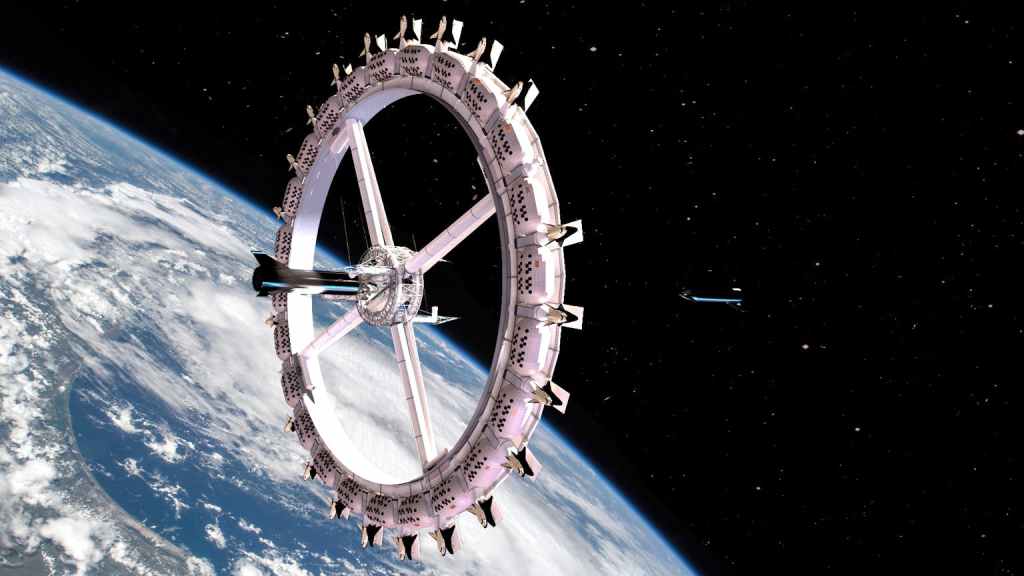
Some time in the middle of last year, news started circulating about a new “space hotel” called Voyager Station. As usual, the reporting on this so-called space hotel was completely credulous. I scrolled through three pages of Google results for “voyager space hotel” and found not a single article attempting to fact-check the ludicrous claims made by this company.
What is the Voyager Station?
The claim, broadly speaking, is pretty simple: Voyager Station, built by a company called “Orbital Assembly Corporation,” (OAC) will be a hotel that can hold up to 280 guests, 112 crew, a restaurant, a bar, a concert hall, a gym, and a cinema. In space.
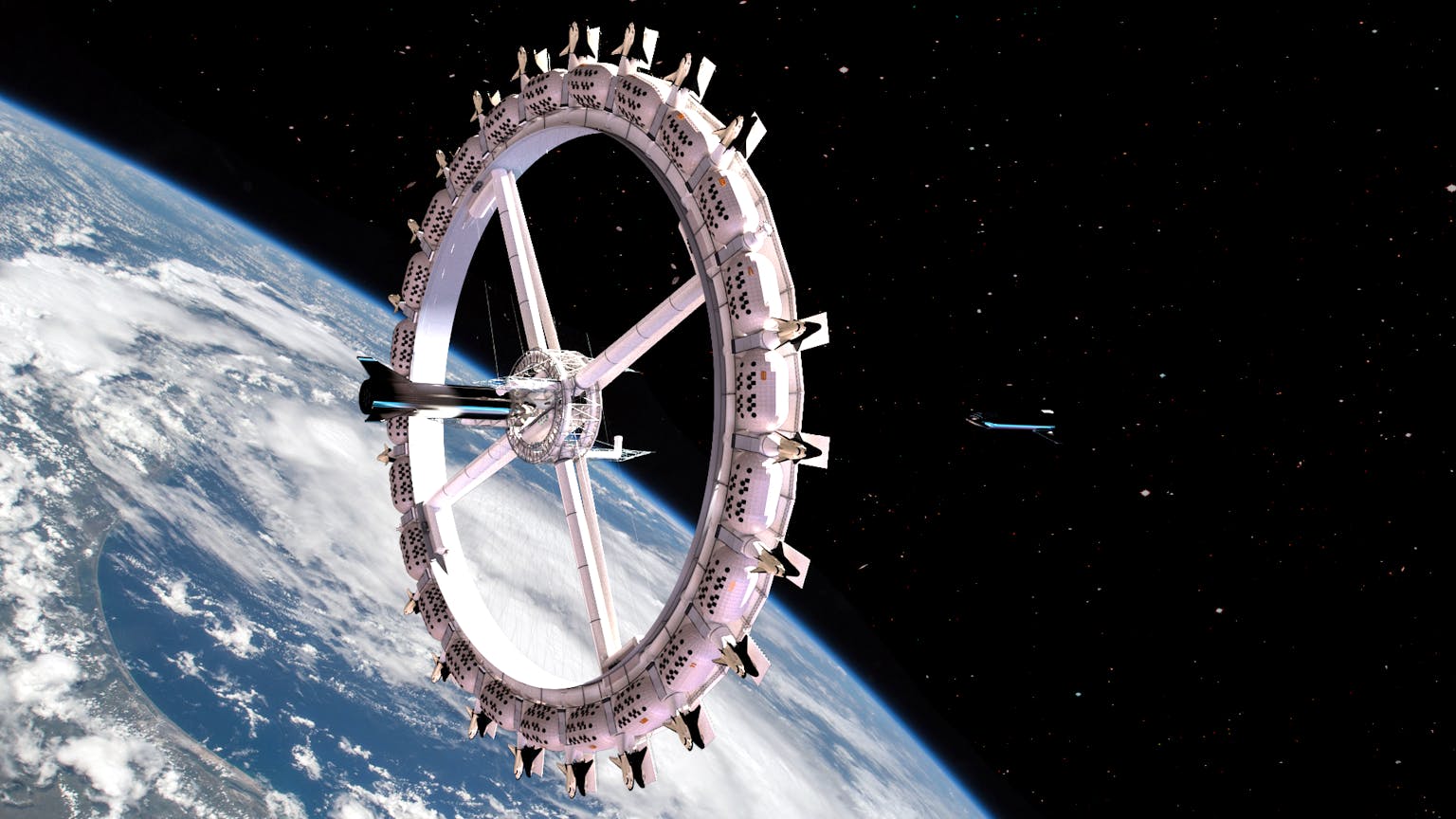
Already I have to interrupt myself because in the two years (oops) since I first found this story and decided to write about it, OAC has changed its name to ABOVE. They also, despite still prominently featuring the image above on their site, seem to have…stopped talking about a space hotel altogether?
They have a tab for “Hosted Payload,” where you can ask for a quote for them to launch things into space for you. They have a tab for Prometheus, which has something to do with creating a pressurized environment in space that they can then “scale to habitable platforms,” so that’s hotel-adjacent I guess. And they have a tab for “Archimedes,” which says this:
The Archimedes program gets its name from the Greek mathematician and engineer who, among other well-known scientific and mathematical accomplishments, theorized that the power of the sun could be harnessed as one of the most valuable tools and formidable forces man might ever wield. We feel he was 2,311 years ahead of his time.
Archimedes didn’t actually say a goddamn thing about harnessing the power of the sun except maybe to theorize that it could be focused for use as a weapon, but even that was probably never used and possibly not even his idea. In any case, the Archimedes project seems to be basically space-based solar panels, which are a bad idea and won’t work, as I’ve written about before.
What about the space hotel?
They’re pretending it never happened, I guess. A search for “voyager site:abovespace.com” turns up nothing but merchandise — you can still buy posters and mugs and t-shirts of this hypothetical hotel — but no actual articles.
Lucky for you (and me, a career procrastinator), there are still lots of articles from the halcyon days of *checks notes* just two years ago, when they had grand ideas of a space hotel that they have since ignominiously discarded. And lest you think I’m being unfair by mocking a project that they no longer claim to be building, they’re still forwarding old links to their “The Future” tab, they still sort of claim to have a plan for artificial gravity in space, and they’re still using the fucking image, so as far as I’m concerned, it’s fair game. Plus, they’re not the only ones. More on that later.
So what was the plan?
Well, like I said in the intro, the plan was for a space hotel that would hold up to 280 guests, 112 crew, a restaurant, a bar, a concert hall, a gym, and a cinema. It would presumably be ring-shaped, like in the picture, and it would have lots of places to dock shuttles around the edge for some reason, plus a place to dock big rockets in the middle.
:max_bytes(150000):strip_icc():format(webp)/voyager-station-suite-interior-rendering-SPACEHOTEL0321-f320218792334fe1a9008404f4d21b6f.jpg)
The inside (there aren’t many renderings of this) would be what you expect from a luxury hotel room, apparently, complete with big windows and flowers and spacious expanses of carpet.
The original plan was that this hotel would open in 2025, which was always laughably ambitious, but I guess they’ve completely abandoned that idea so I can’t focus on it. They also had a smaller plan for a smaller station named Pioneer (very original), which they’ve also completely scrubbed from their website but apparently was going to look like this:
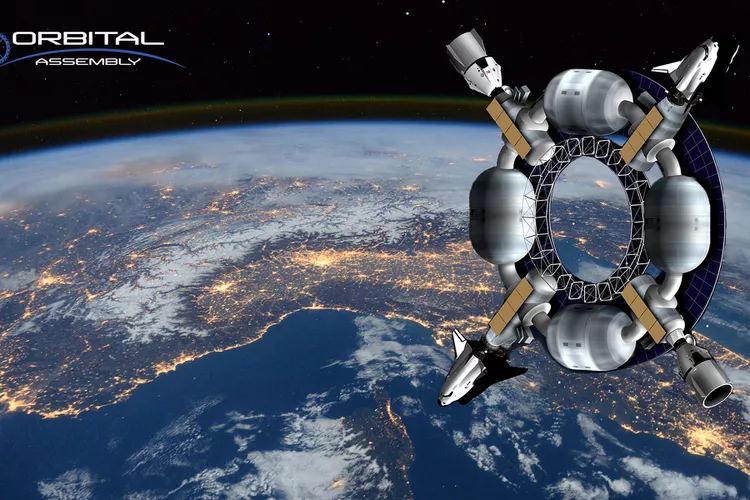
Pioneer was going to hold 28 people in a “blended commercial, research, and tourism facility.” Sure.
Let’s talk about artificial gravity
One of the things that’s mentioned in every article about this “hotel” is that you won’t float around because there will be gravity. OAC’s new website is still obsessed with the idea, too, but…it’s complicated. Here’s what their site says:
The ability to offer customizable, variable gravity, even at low levels, makes more commercial activity, and specific critical applications in space, viable.
Gravity is even more critical in the area of space habitation. Our inevitable long-term future in space depends upon it.
Without gravity, the human body declines in ways that make long-term, sustained occupation of space impractical.In a first-of-its-kind comprehensive review of gravity research commissioned by ABOVE and published by Dr. Mae Jemison, former NASA ISS astronaut, and Ronke Olabisi, Ph.D. at UC Irvine, the difficulties of space habitation without gravity were illuminated:
- Human physiology declines from continuous microgravity environments.
- The long-term negative effects of weightlessness on human physiology have been well-documented.
- Non-astronaut human habitation requires an environment that is closer to earth’s gravity (e.g. eating, sleeping, and hygiene).
- Controllable, variable gravity is the pathway to a sustained presence in space.
ABOVE offers a detailed roadmap to achieve gravity in space.
I’m not going to argue with the idea that gravity is important for long-term space travel, and the negative health effects of long-term microgravity are indeed well-documented. But if you go to their website, there are no links in that paragraph. The “review” they’re referring to seems to be this one, but I want to focus on that last line: “ABOVE offers a detailed roadmap to achieve gravity in space.”
They don’t. That’s the end of the copy on that page. There is a link that says “If you’re interested in learning more about our company and product roadmap, visit this link,” but that link isn’t a link, it’s an email address to rhonda@abovespace.com. Presumably that refers to the CEO, Rhonda Stevenson, who evidently has enough free time to explain their artificial gravity roadmap to you if you email her directly. Which seems weird. I didn’t email her.

Anyway, the way that artificial gravity is supposed to work is that the whole station spins, and then via centripetal/centrifugal force, the outside of the ring where the rooms are experiences gravity. How much is not clear — the “review” says that “even 0.5G might be effective” but one of the articles says “moon-like gravity,” which is 0.17G — but the principle is sound.
The problem with artificial gravity is that weird things happen on such a small scale.
For one thing, gravity is unevenly applied. The closer you are to the center of the hub (like your head), the less gravity you feel. This means that your feet feel more gravity than your head, which leads to perceived tidal forces where it feels like your head is being pulled away from your feet. The concern is that these tidal forces will lead to significant disorientation and nausea, which might be more intolerable over time than the adverse effects of microgravity.
If you look back at the station in the image, the radius of the ring appears to be about three times the length of one of the big shiny rockets in the middle. Since that’s apparently a SpaceX Starship rocket, I know that it’s about 120m (400ft) tall, which means the radius of the station is around 360m (1200ft). That’s more than enough to mitigate the tidal effects of gravity, but it comes with a new problem: it’s fucking colossal. Launching that much material into space is wildly impractical, considering the ISS required 42 assembly flights to get it to its current state and is a relatively paltry 110m (400ft) long by comparison.
The astronomical cost of the Voyager
See what I did there?
I’m not going to go into a ton of detail about the logistical problems, since Voyager is technically a dead project. They seem to have completely abandoned it, erased all references to it (except the gift shop), and made no announcements to that effect on their press page, despite apparently taking reservations on a page that doesn’t work anymore. Here’s hoping they had a good refund policy
Let’s do a quick cost rundown:
- Building the thing would take hundreds of launches at a cost of, at best, tens of millions of dollars each.
- Keeping it supplied would be insanely expensive. Remember, it’s supposed to have 400 people on it, and the ISS has seven. Keeping the ISS supplied costs about $65 million per mission, and has to be done every 2-3 months. Multiplying that number by a factor of 60 means roughly one resupply per day at a cost of $3.9 billion per year, and that’s assuming the same level of creature comforts as the ISS, which is none. If you want bedsheets and fresh veggies, it’ll be massively higher.
- You also have to get people up there. A Falcon 9 can hold seven people in a Dragon capsule, so it takes another 40 launches to fill the hotel.
- Apparently people only stay three days, so you have to do that about 120 times a year at $50 million each (currently $70 million but let’s be charitable and assume there are economies of scale).
- You have to pay the staff, which is a drop in the bucket, but still.
- Maintenance will cost money, and I have no idea how much, and it doesn’t matter.

So let’s add that up.
- Construction: “tens of billions” according to a webinar they did in 2021. Let’s very generously call it $20 billion because no one knows.
- Supply: $3.9 billion per year
- Passenger transport: 280 people on three-day stays means an average of 93 people turning over per day, which is ~14 rockets per day, which is 5110 rockets per year, which will cost $255 billion per year.
That means the first year of operation, if all of this was physically possible (it’s not — the entire human combined can’t put 15 rockets a day in LEO), will cost something like $275 billion.
You’d have to charge $8 million per person per three-day stay to break even, ignoring maintenance and any lost rockets (Falcon 9’s success rate is quite good at 412/415, but that still means losing 37 rockets per year with the numbers above, and the accompanying fatalities and logistical problems that go with.
And how much did they originally claim this would cost?
The company hopes that rates become more reasonable over time. It should eventually cost the same amount as “a trip on a cruise or a trip to Disneyland,” the team told CNN Travel.
Somehow, I don’t think so.
Why do people keep promising these?
The obvious answer is money, I guess. There are plenty of rich dumbasses out there who might throw a couple of million at the vague possibility of staying in a space hotel just as they might throw a couple of million at a painting they don’t like because a decorator told them to. It’s hard to tell exactly how much money OAC/Above has raised, but it’s certainly in the millions.
And I also understand that investors don’t like being told “30 years, maybe” when they ask when they’ll get their money back. But still, this trend of promising a space hotel in single-digit-year timescale is ludicrous. Let’s go back a bit.
Voyager Station was originally announced in March of 2021, purportedly launching in 2027.
Pioneer Station was announced at the same time, supposedly launching in 2025.
Axiom Space is another private spaceflight company that announced the Axiom Station in 2017.
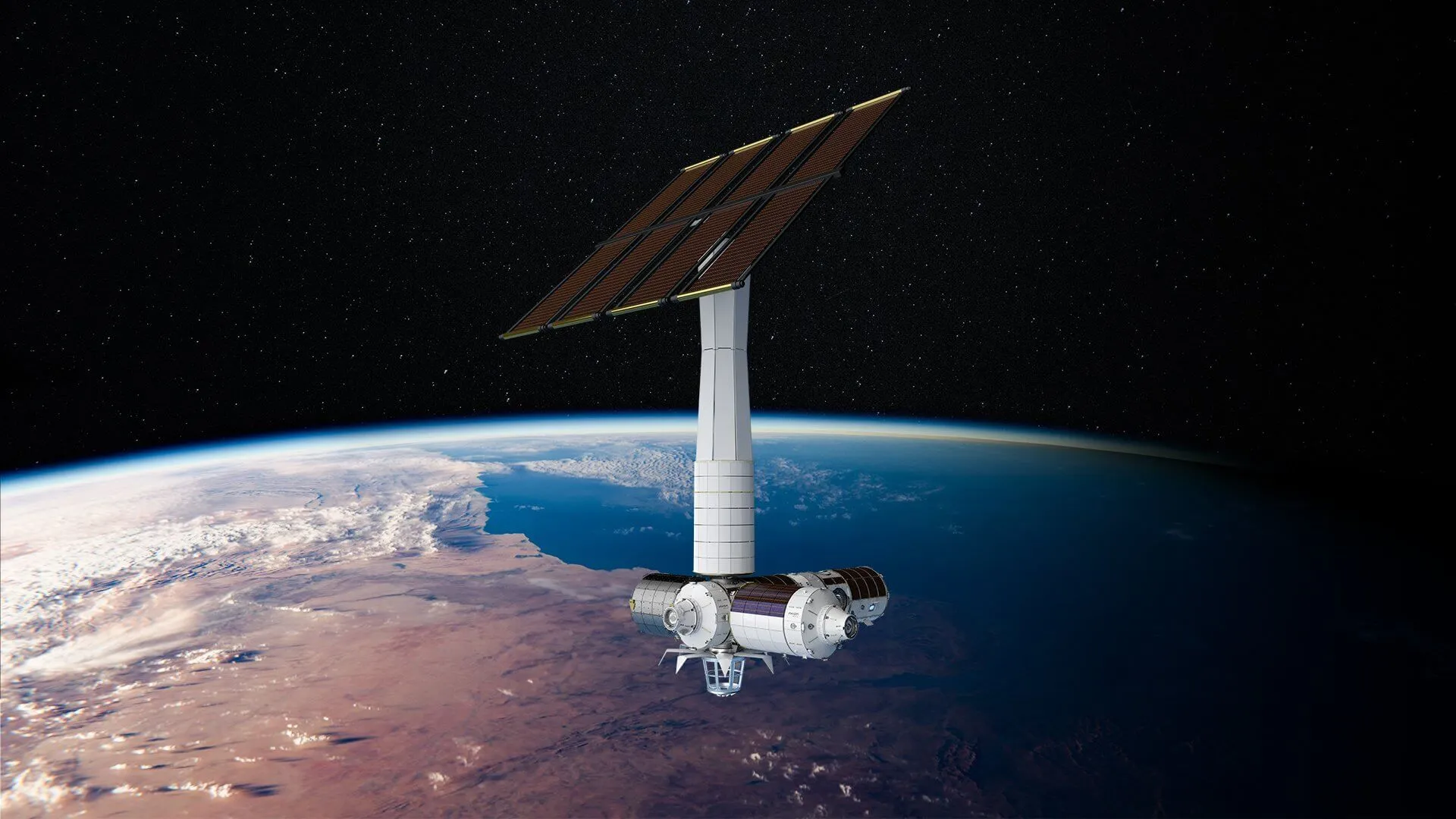
Apparently it’ll start out by attaching these modules to the ISS first, then breaking off to be a separate station…later. NASA picked them to build a hotel on the ISS in 2020, and they said it would be operational in 2024. They now say 2026. So far, they’ve deployed nothing, though their website still says they’re making progress.
Then there’s Bezos’ pet project, the Orbital Reef, which will apparently be a “mixed-use business park” that will serve as a science lab, a hotel for tourists, and much more.

That was announced in 2021 and is apparently going to start working in 2027. It’s not going great…
By October 2023, NASA reported they had paid out only US$24 million of the $130 million contract for completion of specific milestones. Also in early October, issues between Sierra Space and Blue Origin became public, and CNBC reported that the Orbital Reef website had not been updated in over a year, and that no hiring for the project is currently being done, as both companies have other larger space projects that are higher priorities for them. CNBC also reported that the two partners on the project may go their separate ways.
There’s Starlab, announced in 2022 and apparently ready to operate in 2028 “if development continues beyond the initially-funded phase in 2021–24,” which is apparently is still doing.
There’s Haven-1, which was announced in 2023 and is supposed to be operational in August 2025.
There’s Haven-2, which was announced in October of 2024 as the sequel to Haven-1, which doesn’t exist yet, and is supposed to be ready by 2028.
There’s the Bigelow Aerospace station, which was announced way back in 2005 and has since been canceled.
There’s the Northrop Grumman station, which was announced in 2021 and canceled in 2023.
So far, no commercial space stations or even pieces of them have ever been launched.
Why Voyager is so much crazier
Most of the other ones listed above are made of one or a handful of small modules, intending to be launched by rockets in small batches and then inflated and assembled in space, all of which is pretty plausible. Voyager is not that.
Voyager would be the largest space station in human history by a factor of ten, made using construction techniques that don’t exist, kept habitable by artificial gravity techniques that don’t exist, and kept stocked by rockets that don’t exist.
Space hotels have been the starry-eyed dream of space nerds for decades — right up there with space elevators, solar power beaming down from space, and other sci-fi fever dreams. (And, surprise surprise, space-based solar power made a guest appearance in Orbital Assembly’s investor pitch. Go big or go home, right?) Back in the day, these were the must-have ingredients for a future dripping with space-age cool.
But look around now — space is buzzing with action: reusable rockets, megaconstellations lighting up the night, robots headed for the Moon. The vibe? Way more “real-world progress” than “1970s paperback cover art.” Turns out, this is the best moment in history to be in the space game, and not a single one of these advancements hinges on some groovy old-school fantasy about orbiting condos and solar power stations.
Maybe, just maybe, the space crowd has finally moved on. Turns out, you don’t need a floating Marriott to make space awesome. Orbital Assembly’s fancy hotel plans? Cool, sure — but not remotely necessary to keep the momentum rolling. Let’s just keep things slightly in perspective.





 UNREASONABLY DANGEROUS ONION RINGS
Leave a reply to oosw Cancel reply