Every once in a while, I think about how many of my posts come from Inhabitat. Sometimes I feel like this blog is just becoming a response blog to everything they post, and I wonder if I should change the name of the blog to some clever pun like Incompitat or Inhabijustshutthefuckupalready. Sometimes I think I should just lay off.
But then I remember just how much bullshit comes out of Inhabitat, and I decide to hold the line. Maybe one day they or one of their authors will have a Google Alerts on their own name and they’ll see this and be just a tiny bit ashamed of what they’ve done. And so I continue to write.

Our most recent headline looks like this.

Now, that sounds fine because air purifiers are a thing, but let’s not get ahead of ourselves. First of all, it removes CO2 from the air, which is plausible, but why? There’s tons of CO2 in the air, and it’s not affecting your personal health directly. In fact — and this may surprise you if you’re the kind of person who’s confused by which way your pants should face — we actually produce CO2 in huge quantities. Roughly 130 gallons of CO2 per person per day, to be exact-ish. So let’s examine the adorable item in question.
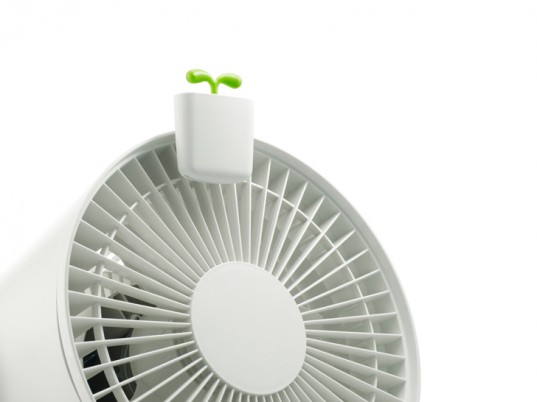
That looks … useless. How does it work? Some kind of chemical magic? Or is it some sort of moronic hippy ingredient that smells nice and is environmentally friendly and doesn’t do anything?
The device uses a natural system to purify air – it’s filled with tiny beads that are impregnated with essential oils extracted from fir trees. When air flows through the beads they remove carbon dioxide and limit the production of radical oxygen, hence providing cleaner air.
Well … fuck me. It’s the second one. Fir oil. I’m not sure if this is even worth pointing out, given the combination of drooling idiocy and doe-eyed naiveté we’re working with, but at no point does anyone involved — either from Inhabitat or Nendo — make even the slightest attempt to explain how fir oil is supposed to do that. I’m not even sure, looking at the pictures, that they’ve actually physically made this thing. I think it’s just renderings.
REGARDLESS, I shall ignore the most glaring problems with this thing (that it doesn’t work or exist) and pretend that it both works and exists. Let’s look into this whole carbon sequestration idea first, shall we? Let’s estimate the volume of that little white cup at around four ounces. If we assume absolutely perfect carbon sequestration, which I should stress is not possible, then we’d start with an empty container and end up with a container full of carbon that had been stripped off of CO2 molecules, releasing sweet oxygen instead. That’s literally the best case scenario, which this by definition cannot be. If you could fill four fluid ounces of space with carbon, it’d be about 22 moles of carbon.
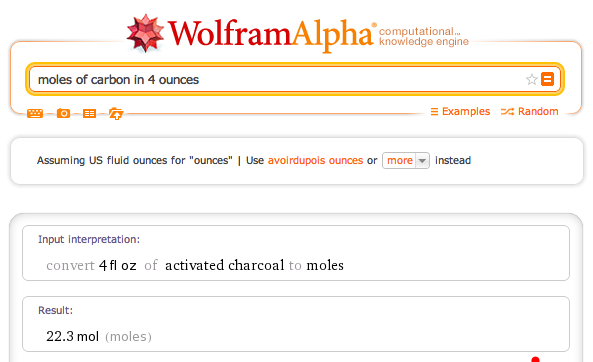
If you then translate that to carbon dioxide (one carbon atom per CO2 molecule), you find out that 22.3 moles of CO2 is around 533 L, or 141 gallons of CO2.
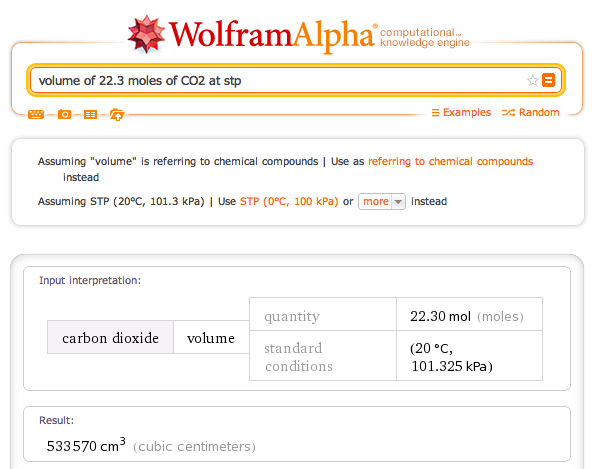
So that’s … that’s the amount of carbon dioxide that the average person produces in 26 hours. That would be great, except for two things. One, it can’t work like that because breaking apart CO2 takes a tremendous amount of energy to do and this has no power source at all, and two, it’s already full of fir oil or what the fuck ever. Clearly, it’s not just an empty container that fills up with carbon. And three, because I forgot there was a third, even if it did work perfectly, under fairy tale conditions, it’d have to be emptied of carbon or refilled with magic tree juice every goddamn day. Which is dumb.
So it’s not good at sequestering carbon, which isn’t even a useful skill in the first place. Moving on.
Tell, me, if you will, what “radical oxygen” is. Don’t know? That’s because it’s sort of not real. I’ll explain, but first, here’s a picture of a tape measure because that came up when I searched for “radical oxygen.”

Radical oxygen is when oxygen is a free radical, meaning it has valence electrons, meaning it likes to stick to other molecules. Normally, molecular oxygen in the air comes in the form of O2, which is two oxygen atoms stuck together. Free oxygen is O1 — one lonely oxygen atom. Free oxygen in the air really only comes from two places: plants and the sun. Plants absorb CO2 from the air and then use the carbon to make more plant, then release a small amount of free oxygen. That free oxygen goes away almost immediately though because it sticks to other free oxygen and then it’s just normal oxygen. The energy of the sun in the upper atmosphere can also break up O2, but again it rejoins into O2 and O3 (ozone) very quickly. The fact is that O1 will stick to almost anything, so it doesn’t stick around. So to summarize: there basically isn’t any free oxygen floating around.
So that’s a dilemma. This thing is designed to reduce the production of free oxygen, but there isn’t any, and it isn’t produced in the air anyway. It’s also designed to sequester CO2, but it can’t do that either. And finally, look back at the picture of it on the fan.
At most, maybe 5% of the air that passes through that fan is hitting that plant thing. So even if it’s really good at what it does (which it’s not), it won’t be catching the majority of the air that’s out there anyway.
But hey, at least it’s only nine bucks.





 UNREASONABLY DANGEROUS ONION RINGS
Leave a reply to Phill Cancel reply