Back in January, the story broke that a Babylonian clay tablet had been examined that gave a different description of a great flood from the one in Genesis. The tablet is about 3,700 years old and is addressed to Atram Hasis.
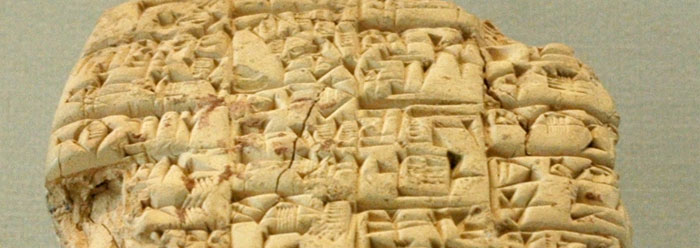 God has terrible handwriting.
Apparently, the translation of the tablet goes as follows:
Wall, wall! Reed wall, reed wall! Atram-Hasis, pay heed to my advice, that you may live forever! Destroy your house, build a boat; despise possessions And save life! Draw out the boat that you will built [sic] with a circular design; Let its length and breadth be the same.
The Institute for Creation Research does not have an especially positive reaction to this, saying that this account of a round ark can’t be real, not because it conflicts with Christianity, but because it doesn’t make sense.
 This is intended to represent the sound of crickets.
My first reaction to this was that it’s further evidence of the unoriginality of the Bible. Almost every story in the Bible is told somewhere else first (including virtually every aspect of the life of Jesus), and it seems to me that it was just thrown together from the various myths and stories that happened to be floating around the Mediterranean at the time. The ICR, of course, sees these redundancies as additional evidence for the historical veracity of the Bible. Here’s their website.
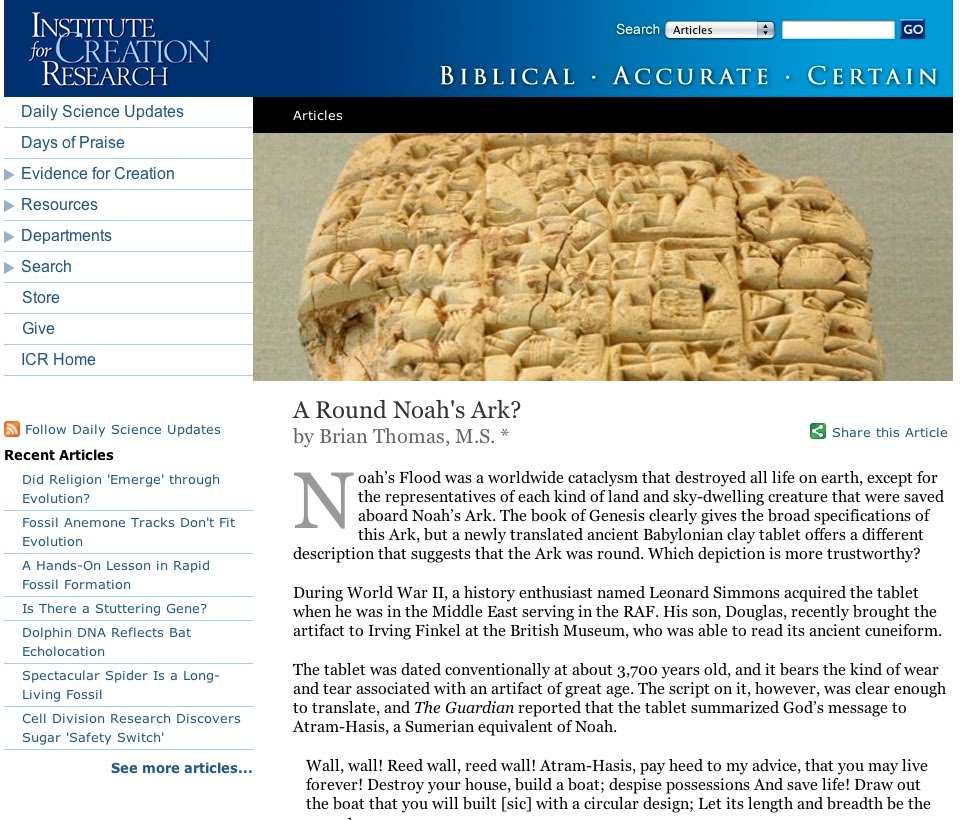
Anyone see a problem with that? No? Let’s look closer.
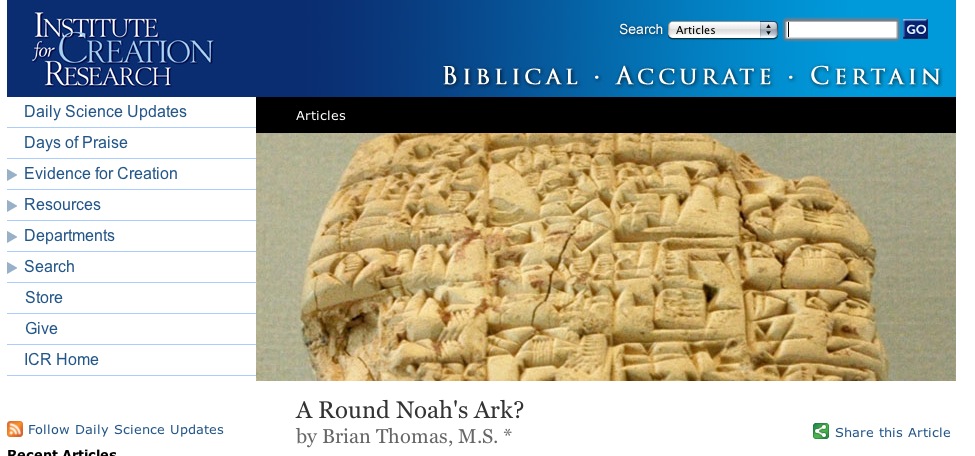
Still no? Let’s zoom in one more time.
 Oh there it is. This is a problem if you’re trying to be taken seriously, but I will try. They make some valid points, like the fact that building a boat to hold all the world’s animals out of reeds is a terrible choice of building materials. It should be noted that the tablet doesn’t say a damn thing about animals, but hey, whatever lets the ICR sleep at night. They also point out that a circular ark would be incredibly unstable in a “violently turbulent flood event.” That’s probably true, but your precious Bible very specifically says that “the waters prevailed, and were increased gently [emphasis mine] upon the earth” (Genesis 7:18), not “the waters smashed the shit out of everything in a violently turbulent flood event.”
 Pictured: the wrath of Almighty God
The article concludes that “the biblical account is a trustworthy account of real history.” If you think I’m going to let that slide, you must be new here. Pay attention, young ‘uns, you won’t forget your first time.
The story of the flood is so riddled with contradictions that it’s difficult to actually read through the whole thing without getting confused. Here’s the gist of it.
Genesis 6:5 – God sees that “the wickedness of man was great in the earth, and that every imagination of the thoughts of his heart was only evil continually.” Let’s keep in mind that God created them in the first place, and in his own image. Doesn’t speak well for the guy.
6:7 – God decides that he regrets making mankind, so he’s going to kill everything on the earth. Not only humans, everything.
6:9 – Except Noah. Noah is “a just man and perfect,” which is why three chapters later (Gen 9:20-25) he plants a vineyard, gets shit-faced, passes out naked, and then curses Canaan to a lifetime of slavery because Ham (Canaan’s father) has the decency to cover up Noah’s 600-year-old man junk.
6:13 – God reiterates, in case you missed it, that he’s going to destroy every living thing in the world to make the world less violent.
6:15 – God tells Noah to build an ark 450 feet long, 75 feet wide, and 45 feet tall. As an afterthought, he tells Noah to cut a square window eighteen inches across for ventilation.
7:2 – God tells Noah to bring in seven of each clean beast and two of every unclean beast, or possibly two of everything (Gen 6:19, 7:8, 7:9: 7:15), because the omnipotent creator of the universe is really bad with numbers.
 God’s grasp of mathematics.
7:17 – The flood lasted either forty days or a hundred and fifty because math is hard (Gen 7:24, 8:3), and then went away.
8:6 – Noah opens the window for the first time in either five or twenty weeks, which is totally gross, and sends out a dove. The dove doesn’t find anything.
8:11 – One week later, the dove has apparently found a fully grown, living olive tree.
 Olive trees can live up to a thousand years. They can withstand frost, wind, attacks from insects,
and the burning, universe-consuming fury of God himself.
8:13 – The earth dries out on the first day of the first month
8:14 – The earth dries out on the 27th day of the second month. It’s like when you run the dryer and it says it’s done, but your clothes aren’t really dry and you have to run it for another seven weeks.
8:20 – After all the animals get off the ark, Noah takes one of each clean beast—the ones he just spent so much time and effort to protect and of which there are only two in order to guarantee the continuation of the species—and kills them. God is pleased, because he forgot that he told Noah specifically to save them just a few months ago.
8:21 – God explains that after killing everyone because humans are inherently evil (Gen 6:5), he will never do it again because humans are inherently evil.
After reading that, it should be abundantly clear to you that God is perfect, omnipotent, and infallible, and that the word of the Bible should be taken literally. I only covered three of the 1200 chapters in the Bible, but rest assured that it does not get better.
The next time a Christian tries to tell you that something does not make sense, punch them in the mouth.






 UNREASONABLY DANGEROUS ONION RINGS

Leave a comment