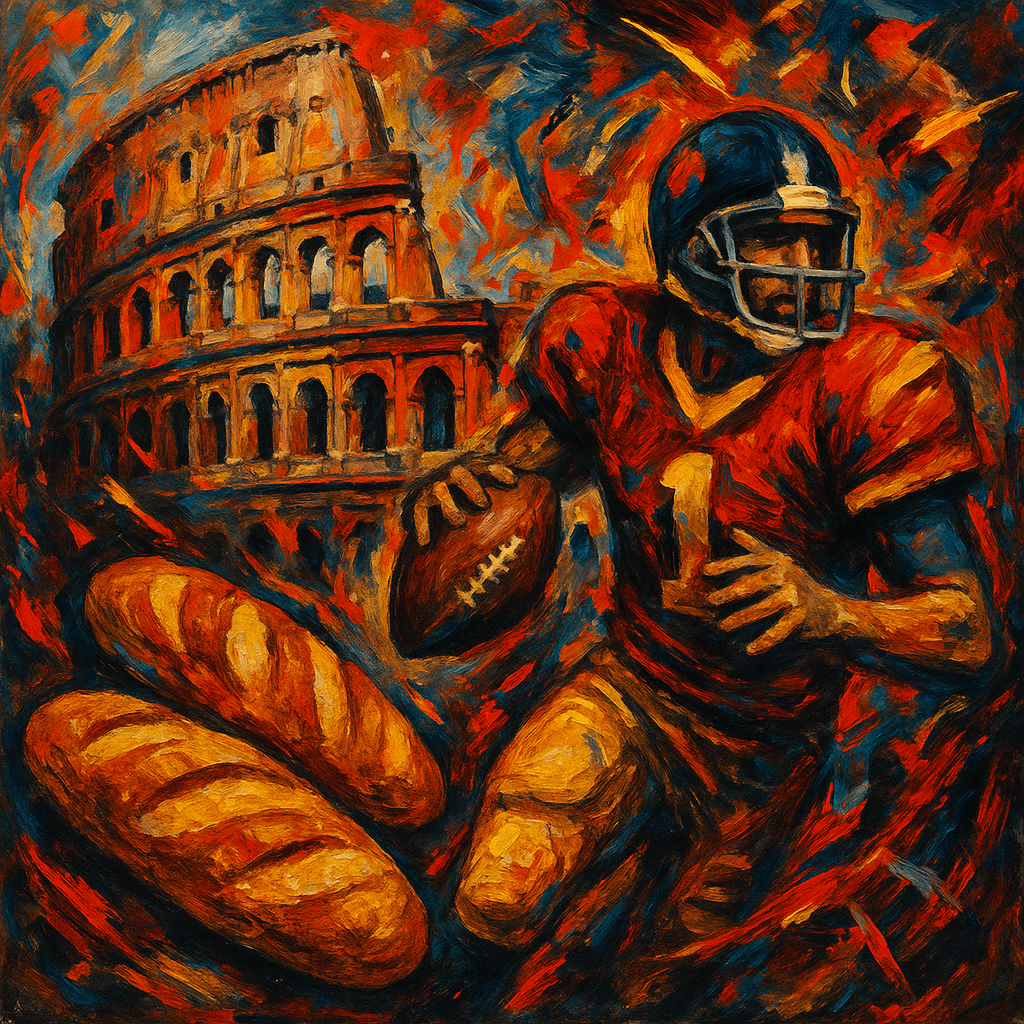
If you’re as perpetually online as I am, you’ve probably run across the phrase “bread and circuses” before, usually in the form of sports-hating edgelords posting memes like this:

Sometimes the phrase above is attributed to Juvenal, the ancient Roman satirical poet who supposedly said this. Well, it’s Thanksgiving, the day when Americans eat the most bread and watch the most circuses of any day of the year (citation needed), and you’re clearly desperate if you’re reading this, and maybe you’ll be able to pick a fight with your smug Libertarian uncle over it, so let’s get into it.
What the “Bread and Circuses” Quote Supposedly Means
The way it’s usually presented implies that Juvenal was instructing Roman politicians as to the best means of keeping the populace entertained and therefore pacified. The Romans followed his advice and built the Colosseum, whereas the modern equivalent is sports stadiums.
The thinly veiled implication is that anyone who likes watching sports is an idiot being manipulated by their conniving government into lowering their guard and not paying attention to What’s Really Going On™, that being whatever scandal or conspiracy du jour we would all be outraged about if we weren’t so obsessed with our sports teams.
Here’s the problem.
That’s Not What Juvenal Said
Like I mentioned before, Juvenal was a satirical poet. His most famous works were the Satires, a collection of satirical poems written around 2,000 years ago, mostly criticizing Roman society. The first one starts:
Difficile est saturam nōn scrībere. nam quis inīquae
tam patiēns urbis, tam ferreus, ut teneat sē..
It is hard not to write Satire. For who is so tolerant
of the unjust City, so steeled, that he can restrain himself
Anyway. The famous one is Satire X, which reads, in part:
iam pridem, ex quo suffragia nulli
vendimus, effudit curas; nam qui dabat olim
imperium, fasces, legiones, omnia, nunc se
continet atque duas tantum res anxius optat,
panem et circenses.
Already long ago, from when we sold our vote to no man, the People have abdicated our duties; for the People who once upon a time handed out military command, high civil office, legions — everything, now restrains itself and anxiously hopes for just two things: bread and circuses.
If you read that closely, or not that closely, you’ll notice that “give them bread and circuses and they’ll never revolt” is not in that passage. That’s not what he said at all.
But this isn’t just nitpicking. The quote that gets floated around is written as though it’s advice to the leaders of Rome, Machiavelli-style. Like Juvenal was a cunning manipulator, advising the Caesars of the time that if they merely plied the people with food and entertainment, they could enjoy unchallenged power as a result.
That’s clearly not what’s happening here. Juvenal isn’t writing to the leadership, he’s complaining about the people. Like I do. He’s bemoaning the fact that there was a time when “we sold our vote to no man,” when the people ran the country through the uncorruptible principles of democracy. Romanticized or not, Juvenal is mourning a time gone past when people cared about the fate of their nation.
Now, he complains, the people only care about two things: bread and circuses. So all these edgelords who think they’re making a point about manipulative leadership and easily manipulated sheeple are making the wrong point.
This should be rendered obvious by the fact that the government does not generally provide us with entertainment. They did in ancient Rome, but they don’t now. Professional sports are funded by capitalistic forces, and yes, there are government subsidies on stadiums every few years, and yes, there are paltry grants for stuff like PBS, but in general, the entertainment industry has almost nothing to do with the government. We pay for it every time we want to partake.
Even if the quote was “give them bread and circuses…,” no one is giving us the fucking circuses.
There’s More Than One Kind of Circus

Just for fun, I went to the home of internet edgelords, Reddit, and poked around for people who use the phrase in the incorrect sense from the beginning of this post. Here are some choice excerpts:
The romans had a saying of bread and circuses, meaning keep the people fed and entertained and you can oppress them and treat them badly.
Painfully accurate.
People treat politics like sports. There’s “my” team and “your” team and political discourse is about on par with my city’s footbal team vs your city’s footbal team discourse
Got into a argument with sister about world collapsing around us . Used this line on her because the family is obsessed with hockey
This is not even an implication really, it’s just how it is. If you’re aware of the concept of bread and circus from ancient times and hadn’t put it together that sports/movies/TV etc are all part of the “circus” then you probably never thought about it for more than 5 seconds. I am regularly surprised how many people don’t know about the origins of that concept though…
That one’s ironic.
But the bigger point is that if you scroll through these people’s profiles, you’ll find out that not only do they have tens or hundreds of thousands of Reddit karma, implying a huge amount of time sunk into browsing the platform, but they’re also active members and fans of other communities. TV shows. Movies. Magic: the Gathering. Zelda: Breath of the Wild. Pokemon GO. Supernatural. Olympic pistol shooting. One of them has been on Reddit over a decade.
All of these things are circuses too. They’re all “distractions,” if you believe in such a thing. You shouldn’t. It’s stupid to think that just because a person is invested in a TV show or a movie or a sports team that they can’t also care about the state of the world and politics and so on. It’s also stupid to think that professional sports is somehow more of a distraction than any other form of entertainment, which people seem to. I never see the “bread and circuses” meme with Marvel movies.
This also conveniently ignores the massive history of athletes using their platforms for political activism. Remember the whole Colin Kaepernick thing? Muhammad Ali refused to be drafted into the Vietnam War and it went all the way to the Supreme Court. LeBron James helped create the “More Than a Vote” campaign to increase voter turnout. Megan Rapinoe has been a huge voice for the causes of equal pay for female athletes and LGBTQ rights. Billie Jean King was a pioneer for gender equality in sports. Kareem Abdul-Jabbar protested the 1968 Olympics to protest racial discrimination. Enes Kanter Freedom has been branded a traitor by his home country of Turkey for protesting against them.

Tommie Smith and John Carlos doing the Black Power salute at the Olympics. Naomi Osaka wearing face masks with the names of victims of police brutality. Craig Hodges writing a letter to George Bush about racial injustice. Serena Williams. Martina Navratilova. Eric Reid. Lewis Hamilton. Maya Moore. Do some Googling, the list is long.
If sports are supposed to be a distraction from societal issues, why are the people playing sports always talking about societal issues?
What About the Fucking Bread?
Remember the original quote? “Panem et circenses.” Bread and circuses.
Side note: it’s no coincidence that the capital city in The Hunger Games, a story about a society under the oppressive thumb of a dictatorial government but appeased by the opportunity to participate in and/or spectate gladiatorial games and earn free food by doing so, is called…Panem.
But that’s sort of the point. The bread and circuses not only have to be provided by the government in order for the “and they will never revolt” crowd to have a point, they have to be free.
In Rome, they were. The Colosseum was built (sort of) at taxpayer expense. Technically, it was funded by the spoils of Roman conquest, but those spoils were effectively public resources, since they came from military efforts funded by taxes. The actual labor was done in large part by slaves and prisoners of war (kind of the same thing in this sense) and the whole thing was built to curry favor with the Roman people.
Then there was the bread. What Juvenal is referring to is cura annonae, which was a Roman policy of importing grain and distributing it to the residents of Rome. At its peak in the 2nd century, this was roughly a million people, so it was no mean feat of distribution.
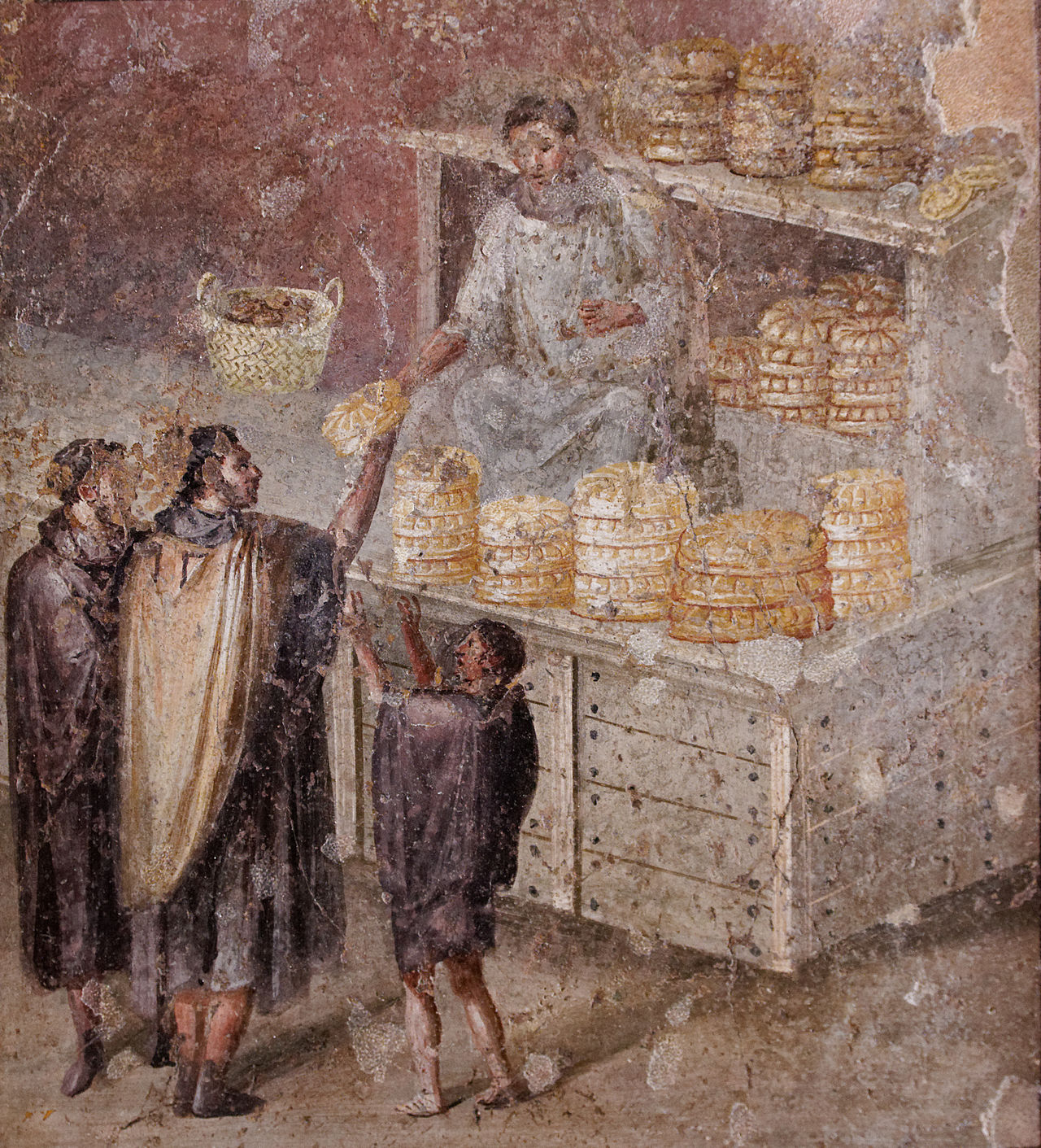
It started as an emergency measure during shortages but became solidified as Roman policy, and the population and leadership came to expect it. In 22 AD, Augustus’ successor Tiberius publicly acknowledged the cura annonae as a personal and imperial duty, which if neglected would cause “the utter ruin of the state.”
There is no modern equivalent of this. Food stamps are not even close (only about 12% of the population gets them). Universal basic income would be similar, but would still lack the more tangible nature of free food. And yet all these keyboard cynics complaining about the appeasement and subjugation of the population conveniently forget that the whole point of “bread and circuses” is that the government was producing and giving away both of them, for free.
Do you know how big a difference that would make in modern society? First of all, there are 18 million food-insecure people in the US right now, and you can be damn sure that they’d look a lot more favorably at the government if they were getting their basic food needs and Sunday Ticket for free.
And even the people who can pay for their food aren’t happy about it. Food prices are up roughly 30% since 2019, and it became a major issue in the most recent US election, so much so that fully half of Trump voters said that high prices were the most important issue affecting their voting decisions.
These people are stupid. Republicans voted unanimously against the Inflation Reduction Act designed to mitigate this problem, and they voted unanimously against legislation to crack down on gas price gouging, and every single policy outlined by Donald Trump in his presidential campaign will make consumer prices worse, and yet all he has to do is say he’s going to bring prices down and 40 million people claim to care enough about that issue to vote for him.
Again, they don’t actually care about that issue because if they did, they’d have done one single iota of research and found that Republicans don’t give a shit about the working class and never have, and they’d have voted for Kamala Harris, but they didn’t do that research because, to reiterate, they are stupid.
But the fact remains that the price of food is such a pervasive hot-button issue that even morons who can barely put their pants on one leg at a time claim to care so much about it that they’ll vote for a man with naked fascist ambitions, just in the vague hope that their hamburgers will get 20% cheaper.
Can you imagine if Joe Biden had instituted a policy of free food for everyone? A sort of UBI, but to cover your basic food budget? SNAP for everyone, regardless of income level or status? It would have been the most popular government program in history, and you can be damn sure that it would have persuaded the populace to like him and turn a blind eye to basically any other foibles or bad policies he might have.
But here’s the thing: he didn’t. No one has. The closest thing we’ve ever gotten to free food is artificially cheap food thanks to subsidies, which we’re still enjoying despite inflation, and the SNAP program, which most people aren’t using. No one is giving us bread and no one is giving us circuses.
But here’s the most important counterpoint to the whole idea:
It Didn’t Fucking Work
Remember, the whole thing that Juvenal was complaining about was that the populace no longer took its civic duties seriously and had become complacent. So you’d think that Roman leadership could have sat back and enjoyed lasting peace, right?
Not exactly. Within decades of these poems being written, Rome started to crumble. The empire became marred with corruption and an over-reliance on mercenaries, stretching the coffers thin. The Roman peace ended. The nation suffered from frequent changes in leadership, over 20 emperors in 50 years (wonder what that’s like). debased currency and inflation led to poverty. civil wars and internal power struggles broke out.
A plague decimated the population. Frequent barbarian invasions crippled the empire’s ability to grow food or pay for it, and the population of Rome fell by more than half in less than 200 years (it didn’t bounce back to imperial levels until 1930). Political instability and shifting cultural norms thanks to the rise of Christianity gutted the authority of Rome, and the whole thing eventually crumbled.
What Have We Learned?
No, not we as a society. As a society, we’ve learned nothing and never will because everyone is the worst. See: the 2024 election, where morons ruined the country on purpose because they are morons.
What have we learned in the process of reading this post rather than spending time with our families over the Thanksgiving weekend? Well, we’ve learned a few things:
- We learned that Juvenal never said “give them bread and circuses and they were never revolt.”
- We learned that what he actually said had basically the opposite meaning, complaining about political apathy rather than manipulative politicians.
- We learned that modern analogs to the “bread and circuses” idea don’t exist, since the government is providing neither of them.
- And we learned that despite Juvenal’s complaints about a complacent populace, Rome was in serious trouble from both outside and in, and that without competent leadership, the entire nation-state came crashing down.
I sure hope there aren’t any important takeaways from that. Go Packers, I guess.




 UNREASONABLY DANGEROUS ONION RINGS
Leave a comment